Wheels, Walls, and Wonder: Driving Through Dubrovnik’s Timeless Stone Streets
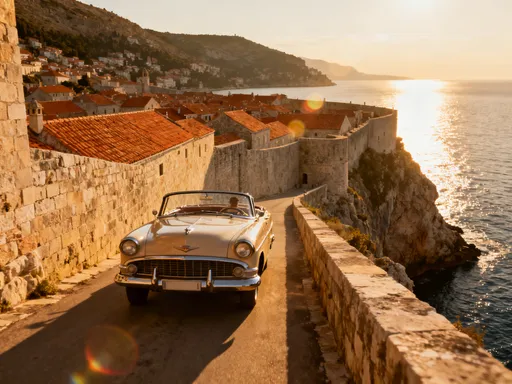
You know that feeling when you’re behind the wheel and suddenly the road opens up to something straight out of a storybook? That was me, arriving in Dubrovnik—ancient walls rising from the sea, terracotta rooftops glowing in golden light. I came for the drive, but stayed for the architecture—every street corner whispering centuries of history. This isn’t just a city; it’s a living museum you can cruise through, one breathtaking detail at a time. The journey there, the rhythm of the road, the way the Adriatic sparkles beside coastal switchbacks—all of it prepares you. By the time you see the first stone tower cresting the horizon, you’re no longer just a traveler. You’re a witness to something enduring, something built to last.
The Open Road to Dubrovnik: Why Driving Changes Everything
Driving to Dubrovnik is more than a means of arrival—it’s the overture to the experience. Unlike arriving by air or ferry, where the city appears almost instantly, the car allows for a slow reveal. Coming from Split, the coastal E65 route traces the Dalmatian shoreline with cinematic precision. Rocky capes plunge into turquoise coves, vineyards climb sun-baked hills, and small stone villages emerge like natural extensions of the landscape. Each kilometer traveled deepens the sense of journey. The flexibility of self-driving means stopping at a roadside fig stand in Makarska, or pausing at the Neum corridor just long enough to stretch your legs before re-entering Croatian territory. This autonomy transforms travel from a transit into a narrative.
For those entering from Montenegro, the route along the Adriatic coast offers equally dramatic scenery. The road winds through the Bay of Kotor’s fjord-like inlets before reaching the Croatian border at Debeli Brijeg. Crossing here requires minimal documentation for EU and many international travelers, and the process is generally smooth during off-peak hours. Toll roads are present on major highways, with fees paid in kuna or by card at automated booths. While signage is clear, occasional construction zones require patience. Mountain passes near Ravni and Klobuk demand cautious navigation, especially in summer when tour buses dominate the narrow lanes. Yet, these challenges are part of the journey’s authenticity.
What sets the drive apart is the anticipation it builds. As you approach Dubrovnik from the east, the terrain gradually shifts. The dense pine forests thin, replaced by olive groves and dry stone walls marking family plots. Then, in the distance, a line of stone rises from the coast—the city’s defensive walls, standing sentinel over the sea. There is no grand sign announcing your arrival. Instead, the city reveals itself subtly at first, then fully, as if emerging from legend. That moment—when the spire of the Sponza Palace catches the afternoon sun—is unscripted, unrepeatable, and made possible only by the freedom of the open road.
First Impressions: The City Walls as a Gateway to History
No image of Dubrovnik is more iconic than its encircling fortifications—massive limestone walls that have guarded the city for over five centuries. Standing at the foot of the Pile Gate, the entrance to the Old Town, one cannot help but feel dwarfed by history. These walls are not relics behind glass; they are tactile, climbable, and astonishingly intact. Built primarily between the 12th and 17th centuries, they were reinforced during the Renaissance to withstand cannon fire, making Dubrovnik one of the best-preserved fortified cities in the Mediterranean. The stones, quarried locally, have weathered centuries of salt air and conflict, yet remain tightly fitted, a testament to the skill of medieval masons.
Visitors arriving by car typically park outside the walls, in designated lots like Garage P4 or the open-air facility near the Gruž Harbor. From there, the walk to Pile Gate is short but profound. Modern vehicles idle at the edge of a world unchanged for centuries. The contrast is striking: sleek rental sedans parked beside centuries-old stonework, tourists in sunglasses stepping over the same threshold once guarded by city sentries. The gate itself is a masterpiece of layered defense—first an outer drawbridge (now fixed), then a vaulted passage with murder holes above, and finally the inner gate protected by a stone archway adorned with a statue of Saint Blaise, the city’s patron.
Walking the walls—either before or after exploring the Old Town—offers unparalleled perspective. The full circuit spans approximately 2 kilometers and provides panoramic views of red-tiled roofs, the deep blue Adriatic, and surrounding islands like Lokrum and Koločep. At the highest points, such as Minčeta Tower, the curvature of the earth seems visible. The walls were designed not only for defense but also for surveillance—guarding against pirates, rival city-states, and later, Ottoman advances. Their preservation today is due in large part to UNESCO designation in 1979 and meticulous restoration after damage sustained during the Yugoslav Wars of the 1990s. Touching the stone, one feels not just texture, but time.
Streets That Tell Stories: Walking the Stradun with an Architect’s Eye
Once inside the Old Town, the Stradun—also known as Placa—serves as the city’s central spine. This broad, marble-paved thoroughfare stretches nearly 300 meters from Pile Gate in the west to Ploče Gate in the east. Its uniformity is deliberate, the result of a city rebuilt with precision after a devastating earthquake in 1667. While earlier structures were largely Gothic, the reconstruction followed Baroque principles of symmetry, proportion, and order. The limestone slabs underfoot are laid in a rhythmic pattern, worn smooth by centuries of footsteps, now echoing with the chatter of tourists and the clink of café cutlery.
What makes the Stradun remarkable is not just its grandeur, but the subtlety of its design. The buildings flanking it rise uniformly to three or four stories, their facades aligned with near-mathematical precision. Beneath the surface uniformity, however, lie clues to social hierarchy. The grandest palaces—once home to noble families like the Sorgo, Bunić, and Gradić—stand slightly taller or feature more elaborate window frames carved with floral motifs and family crests. Some windows are framed with dark stone, creating a chiaroscuro effect that draws the eye upward. Others have iron balconies with intricate scrollwork, now often draped with blooming geraniums.
Along the Stradun, the ground floors house shops and cafes, but the upper levels remain largely residential, preserving the city’s living character. The alignment of doors and windows follows a strict rhythm, a visual cadence that guides the eye and calms the mind. Even the placement of fountains—such as the Onofrio Fountain near Pile Gate—was carefully considered. Built in the 15th century, this octagonal structure once provided fresh water to citizens and still functions today, a symbol of civic engineering. Walking the Stradun is not just a stroll; it is an immersion in urban harmony, where architecture reflects a society that valued order, dignity, and beauty.
Beyond the Postcard: Hidden Courtyards and Overlooked Details
While the Stradun draws the crowds, Dubrovnik’s true architectural soul lies in its quieter corners. Just steps off the main promenade, narrow alleyways branch into secluded courtyards, vaulted passageways, and staircases that seem to climb endlessly. These spaces, often overlooked by hurried tourists, reveal the city’s layered history. The cloister of the Franciscan Monastery, tucked near the western gate, is one such gem. Dating back to the 14th century, its two-tiered arcade features slender stone columns and delicately carved capitals. The inner courtyard is serene, a place of reflection surrounded by orange trees and climbing jasmine. The monastery’s pharmacy, still operating today, is among the oldest in Europe—a quiet testament to continuity.
Another hidden marvel is the network of underground passages and archways beneath residential buildings. In areas like Široka ulica and Od Puča, stone arches support upper floors, creating shaded walkways that stay cool even in August heat. These structural solutions were both practical and aesthetic, allowing for multi-level housing on uneven terrain. Look closely, and you’ll spot carved heraldic shields embedded in walls—remnants of family pride and civic identity. Some bear weathered coats of arms; others display symbolic animals like lions or eagles, each with historical meaning.
Driving allows visitors the freedom to return at quieter times—early morning or late evening—when the crowds have thinned and the city softens. At dawn, golden light filters through narrow lanes, illuminating fresco fragments on forgotten walls. In the stillness, you might hear only the distant lap of waves against the sea walls or the chime of a church bell. These are the moments when Dubrovnik feels truly alive, not as a museum piece, but as a home. Without the constraints of guided tours or ferry schedules, the self-directed traveler can linger, observe, and discover. It’s in these overlooked details—peeling plaster revealing older masonry, a wrought-iron lantern still in use—that the city’s resilience becomes visible.
From Fortress to Villa: How Coastal Architecture Evolved
Beyond the Old Town, Dubrovnik’s architectural story continues in its surrounding neighborhoods. Areas like Lapad, Babin Kuk, and Komolac showcase how coastal living has evolved over the past century. Here, 20th-century villas blend Mediterranean traditions with modern comforts. Unlike the uniform stone of the Old Town, these homes feature stucco walls in soft pastels—creams, blues, and terracottas—that reflect the sun and complement the sea. Roofs are often tiled in traditional red clay, though some newer constructions use flat concrete with rooftop terraces designed for sunset views.
The placement of these homes is deliberate, shaped by geography and climate. Many are built into the hillside, terraced to maximize sea exposure and natural ventilation. Large windows and open balconies capture sea breezes, reducing the need for air conditioning. Architects have long understood that in Dalmatia, design must respond to the elements—stone for durability, overhangs for shade, orientation for cooling winds. Even today, new developments follow these principles, integrating passive cooling and natural light to maintain comfort without excessive energy use.
What’s particularly striking is how modern residents honor the past. In older villas, original stone fireplaces remain, and wooden shutters are preserved for both function and charm. Some homeowners have discreetly added solar panels on roof slopes not visible from the street, blending sustainability with aesthetics. Others have restored historic wells or cisterns, once essential for water storage, now repurposed as garden features. These adaptations show that architecture in Dubrovnik is not frozen in time—it is a living dialogue between heritage and innovation. The city’s identity is not confined within its walls; it extends into the hills, where every villa tells a story of continuity and change.
Practical Magic: Navigating Parking, Permits, and Peak Seasons
While the romance of driving to Dubrovnik is undeniable, practical considerations ensure the experience remains enjoyable. The Old Town is a pedestrian zone—no private vehicles are allowed beyond designated drop-off points near Pile and Ploče Gates. The most reliable parking options are Garage P4, located just west of the Old Town, and the open-air lot in Lapad, about 1.5 kilometers away. During peak season—July and August—spaces fill quickly, and daily rates can exceed 150 kuna (approximately 20 USD). Arriving before 9 a.m. significantly increases the chances of securing a spot, especially on cruise ship days when thousands of visitors arrive by foot.
For those parking farther out, the city operates a reliable shuttle bus service. The Line 1 and Line 8 buses run frequently between Lapad, Gruž Harbor, and the Old Town entrances, offering a stress-free alternative to walking uphill in the heat. The buses are air-conditioned and accommodate luggage, making them ideal for families or travelers with mobility concerns. Using public transit also reduces congestion and environmental impact, supporting sustainable tourism.
Navigation within the city requires caution. GPS systems often misroute drivers through narrow alleys unsuitable for cars. Streets like Obala Sv. Dominika are lined with blue signs indicating restricted zones—entering these areas without a permit can result in fines. Drivers should rely on official maps and local signage rather than digital guidance alone. Additionally, fuel stations are limited within city limits; it’s advisable to refuel before arrival, especially if planning further coastal exploration. With thoughtful planning, the logistics of driving enhance rather than hinder the journey.
Why This Journey Matters: Architecture as Memory, Driving as Discovery
Dubrovnik is more than a destination—it is a testament to human resilience, cultural memory, and the enduring power of place. Its stone walls, marble streets, and hidden courtyards are not merely beautiful; they are bearers of identity. Every carved lintel, every weathered step, speaks of generations who lived, traded, and defended this city. To drive here is to participate in a slower, more intentional form of travel—one that allows space for reflection, discovery, and connection. The car becomes not just a vehicle, but a vessel for experience, carrying you through landscapes shaped by time and tide.
In an age of instant travel and digital saturation, the journey to Dubrovnik by road offers something rare: presence. It demands attention—the curve of a coastal road, the scent of pine and salt, the sudden sight of a fortress emerging from the mist. It rewards patience with intimacy. And it reminds us that architecture is not just about form, but about continuity. The same stones that protected citizens centuries ago now shelter cafes, homes, and dreams. The same streets that hosted diplomats and merchants now echo with children’s laughter and the clink of wine glasses.
To explore Dubrovnik by car is to understand that travel is not only about where you go, but how you arrive. It is about allowing the landscape to unfold gradually, brick by brick, mile by mile. It is about stepping out of your vehicle at journey’s end and feeling, in your bones, the weight of history and the warmth of the sun on ancient stone. In that moment, you don’t just see Dubrovnik—you feel it. And that feeling, once awakened, does not fade. It lingers, like the echo of footsteps on marble, long after the engine has been turned off.